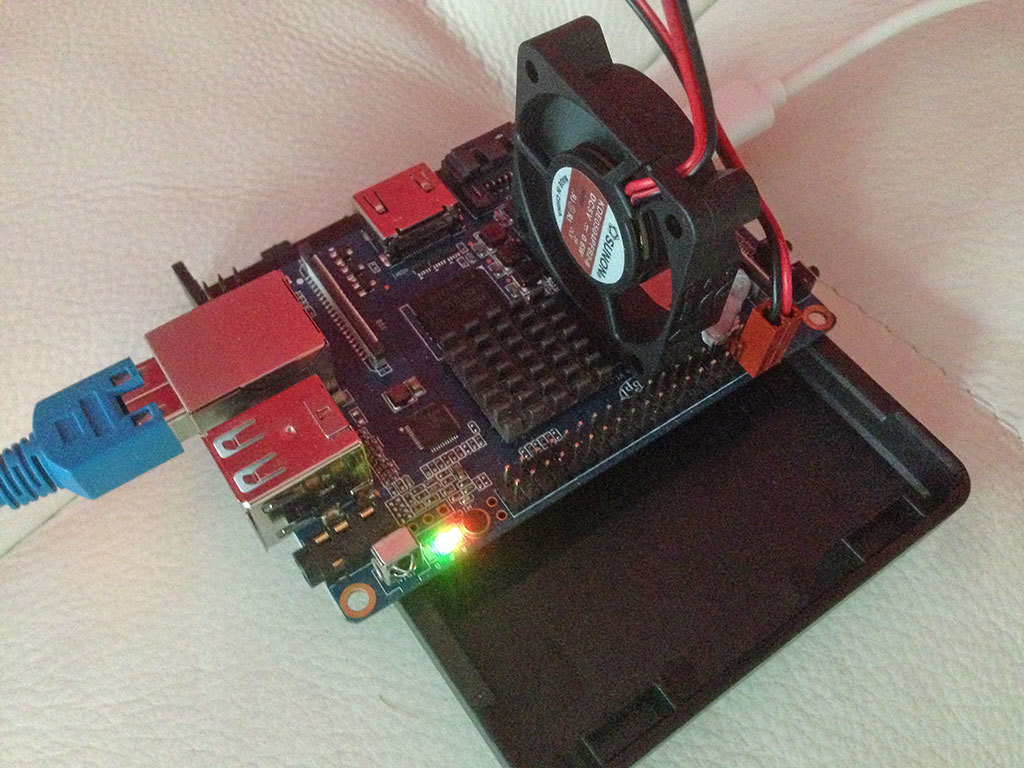
BPI-M3 Heatsink

Minerd bench marks wha ha ha ha. Before the doubling in June of 2015 I built a 400 S1 Antminer farm. We did about 30 coins per day at 2.4 billion transactions. Not a miner but a feed source of many of the American mining pools.

Ok to keep it simple there is an ant miner usb device with asic called a ANTminer U2 it does 2.0G hash per second. There was a S1 Antminer 200G hash per second we used 400 of these units together as a pool seed. Thats 80,000G Hash per second or 80 Tera hash.

SO charles a ice sled does excellent on snow slopes but kind of sucks at the beach. The arm processor is completely the wrong tool for bit coin mining.

Compiling software is actual work and this M3 does pretty good. https://openbenchmarking.org/s/Compiler Benchmarking with bitcoin is really not

The best lite coin miner I saw before the sweep was the R9 AMD video cards I built 4 boxes with 4 cards each. The APU is more suited for coin mining than a CPU or RISC CPU.

Like I said you need an actual heat sink and actual power for the M3 board to work correctly.

My real interest in the processor is for a completely different application. I need a packet altering board Tilera sold MUllenex so the 72 core Tilera GX network processor became less cost effective, I need to support a TOR like backhaul that will have a class A subnet behind it. I am currently using XEON phi processors but the Cost per card just quadrupled and the software has to be compiled on the Intel IDE that does not have the core functionality I need. ARM is actually different than a conventional x86 PC. ArmK the intel version is all back revel on versions to meet the REDHAT Enterprise release schedule. The Tileras are about 28K USD a board and the software is now stuck in back rev hell. http://www.mellanox.com/repository/solutions/tile-scm/

These A83T processors have great potential for my application. I can populate 8 on a PCI-E card and network them with 9600Mbs network PCI links like the Xeon. This is kind of what I am working on. http://www.advantech.com/products/half-length_pcie_card1/dsp-8684/mod_7fa46fcd-ca8d-4f3d-808f-419cf50119aa

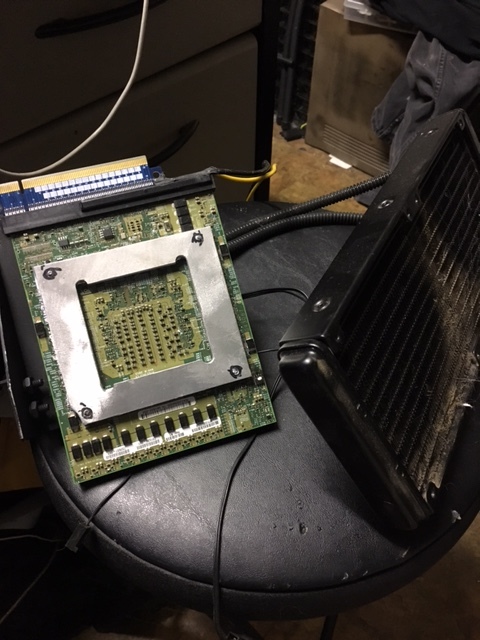
This is a 60 core Xeon Phi 1GHz with a 160X radiator attached for cooling it gives 120 threads per card at about 4.5K USD per card.

Almost all of the compiled arm stuff I have seen was built on one of three toolchains. SUNXI , EIBI and LInero. The mis configuration is in the fact that the GCC does not recognize this particular chip by it’s ident. On the SunXi tool chain it’s defaulted to arm Cortex A5 on linero it is defaulted to Cortex A6. It is partly because the chip is outside of the official ARM groups released chips and partly I think due to all the bitching and whining about it causing a lot of animosity when the group may have been better served by just doing what I am doing. Build a separate tool chain and repo. Here is the listing of codes for ARM7 that the compiler recognizes no Arm7L on the list.

minerd --benchmark is able to show the efficiency of heat dissipation when throttling is likely to occur (it’s easy to understand this). Since you fail to provide numbers I guess your expensive milling adventure performs as poor as my cheap setup. Thanks for providing walls of text without any contents.

Wish you good luck.

You know Charles I believe that open forums are plagued by the decent into argument.

I see what you have and what you believe they are indicative of a lowly troll.

I provide you with real information to allow you to learn where your assumption is wrong.

Your 50cent investment in solving your issues does not afford you the expertise to say anything at all.

As for performance benchmarks, shows you as a complete and utter fool using a bit coin script as a benchmark tool is absolutely hilarious do you even know any code.

Your demand that some one else do the same as you is just freezing ridiculous.

I think that you must have bought a cheap board and failed to do your dream and now hate the fact that any one is pleased with the same board.

My walls of text are because my thoughts are more complex and deeper than the 140 character limit of your attention. They call them tweets because they are noises from bird brains.

You’re funny. So much text and zero understanding. minerd is able to show the efficiency of heat dissipation when throttling occurs. In numbers. Since you don’t provide these numbers it’s easy: your heatsink is as inefficient as mine :slight_smile:

Again: good luck! You’ll have a great time here talking to yourself. Enjoy!

Charles you must be a complete and absolute troll.

If you read all of your posts and look at the child like way you attempted to cool your board you come to the conclusion that you really have no idea what you are talking about.

Your bullcrap bully technique of picking out one inane little thing and happing on it is obvious.

NO you are a complete and utter moron who is trolling people. You are that lowly pice of crap a forum troll.

If you knew even the slightest thing about bit mining or code you would know that bit coin mining is not a bench mark that is valid at all. And no I will not be showing bit coin mining stats for any device not specifically designed for the SHA256 algorithm.

When I finish the kernel toolchain and build the kernel correctly I will post all the results.

CHARLES=TROLL my last word to you.

You’re so funny. So much text and insults all just to compensate for you not being able to show how efficient your heatsink is (since it’s not :slight_smile: ).

CHARLES = TROLL

Every post from charles is adversary troll

Would you have such a ‘Cooler’ for me too? :wink:

It looks perfect. Is it alu?

Greetings from Austria

They are expensive for me to make +200 USD I can if you have the budget. My lab is not set up for production only prototyping so it is very costly for small items.

I am forwarding the design to Sinovoip to find asian casting at much lower cost.

If you have access to a 3d printer you may want to form a bracket that will hold a copper northbridge cooler. A cooler like this one will work nicely as well. http://www.acousticpc.com/swiftech_mcx159cu_all_cooper_universal_north_bridge_chipset_cooler.html

I posted REAL benchmarks and Results.

Only +200 USD, that’s a bargain! Especially for the ‘performance gain’!

Ok, you got with your super cheap heatsink sysbench 20000 results of less than 52 seconds or with the other test a little above 53 seconds (what’s that ondemand/performance thing?). Now let’s google for ‘sysbench 20000 banana pi m3’:

  • first hit: ‘$0.5 heatsink that performs ok’ and ‘sysbench --test=cpu --cpu-max-prime=20000 run --num-threads=8" in less than 53 seconds’
  • second hit: the same guy asking @sinovoip but to no avail
  • third hit: without heatsink it’s 92 seconds

Impressive results! For just $200 REAL performance improves by unbelievable 75 percent compared to no heatsink. And when comparing to a heatsink that costs 400 times less it’s at least an improvement of ZERO percent. REAL benchmarks and not FAKED ones as this cpuminer stuff above!

Good luck!

Let’s see your numbers with my provided software.

You are proving my point for me…

I am not currently selling the heat sinks as you can see. I am providing the design to Sinovoip Inc. threw Ammorexue. The goal is to get them made inexpensively in asia.

You’re so funny. You provide REAL benchmarks using sysbench 20000, get a result of ~52 seconds and don’t understand the meaning of other people without your AMAZING or let’s say REAL heatsink scoring 53 seconds with just an average and cheap heatsink?

Good luck!

minerd is not a benchmark it is a test for bit coin mining that is one calculation iterated.

I have provided you and all with a tool that allows you to verify your work.

I have verified my work and my needs nothing you can do in your world will change the fact that I can successfully use the BPI-M3 for my needs and you have not.

Really? :joy::joy::joy:

I showed you already my khash/s values with my cheap heatsink so that you’re able to understand why your milled heatsink is just an insanely expensive overkill. It’s so easy for you to verify that your heatsink is not worth the efforts. All that’s needed is you starting to understand what’s happening around. Good luck!

You should provide the logs instead of just refuting and trolling.

Load levels on the none standard tests hit 72 not 8 like minerd .

Every post you have ever made on this site provides no benefit only refutation.

Dear auto,

here you find the results as requested: BPI-M3 Heatsink (choose the latest directory called 09-19-46 there)

Not so surprisingly the numbers I got are identical to yours since I made two important improvements in the meantime:

  • BGAs dissipate heat via contacts to the PCB. Allowing some airflow below the PCB improves heat dissipation.
  • Improving the airflow (lateral) on top of the heatsink is more important (of course only as long as we’re talking about improving heat dissipation and not your ‘My heatsink is longer than yours’ game)

You should improve your scripting skills a bit, having to run all of this as root is bad style, not checking for external requirements (‘parallel’ command and the others) is bad style too and your error handling is also bad (ramdisk creation failed). In the end I had to start multiple times your time consuming and mostly useless ‘benchmark’ so please check logs/2017/06-21/08-27-27 log directory to draw the graphs you seem to need.

I was running with interactive cpufreq governor (since the only reasonable choice with this kernel) and my sysbench numbers look like this:

total time:                          51.7640s
total time:                          51.7103s
total time:                          51.7564s
total time:                          51.7369s
total time:                          51.7183s

Yours with performance governor:

total time:                          51.7284s
total time:                          51.6777s
total time:                          51.6585s
total time:                          51.6866s
total time:                          51.6727s

Yours with ondemand:

total time:                          51.6665s
total time:                          52.7399s
total time:                          52.4297s
total time:                          53.1433s
total time:                          53.3066s

I fail to understand the purpose of the other ‘benchmark’ (this funny palindrome thingie) since we’re talking about the efficiency of heat dissipation – how do you want to test this only with very light loads as you always do (you seem to be confused about the concept of ‘average load’ anyway: http://lmgtfy.com/?q=average+load+linux). Of course I won’t repeat those stupid and time consuming tests again with performance governor to show you exactly the same numbers as you got.

If you would’ve chosen cpuminer as suggested by me you would’ve long known that your heatsink is just the expensive and also inefficient overkill as it looks like :slight_smile:

BTW: My board still runs powered by Micro USB from a $7 5.1V/2A PSU but with an appropriate cable avoiding voltage drops.

In case you need further help, eg. how to improve thermal behaviour (fex file magic) or to get higher clock speeds (fex file magic reloaded) just drop me a note. But don’t forget to insult me as you do all the time! It seems to be important to you trashtalking to the persons that try to help you. Don’t give up on this!

PS: Another simple way to test heat dissipation efficiency besides cpuminer is using cpuburn-a7 and then watching how low cpufreq drops or even better check /sys/devices/system/cpu/cpu0/cpufreq/stats/time_in_state prior to 2 minutes cpuburn-a7 and after that and do the math. Already curious about your (low) results :slight_smile:
Nice, you did not even check for stress-ng but think this would be important.

That’s how it looks like after installing all your requirements:

Starting Stress-ng 5 minute run 
Temp: 72C----------Load average: 8.10, 8.49, 20.62

Starting Stress-ng 10 minute run 
Temp: 72C----------Load average: 8.17, 8.39, 19.00

It’s just another light load not able to heat the whole thing up near the throttling treshold. Useless :slight_smile: