Banana Pi BPI-M2C is a high-performance ARM single-board computer (SBC) from Banana Pi, powered by the UNISOC UIS7885 SoC. It is designed for applications such as 5G communications, edge computing, artificial intelligence, machine vision, smart terminals, and embedded human-machine interfaces (HMI).
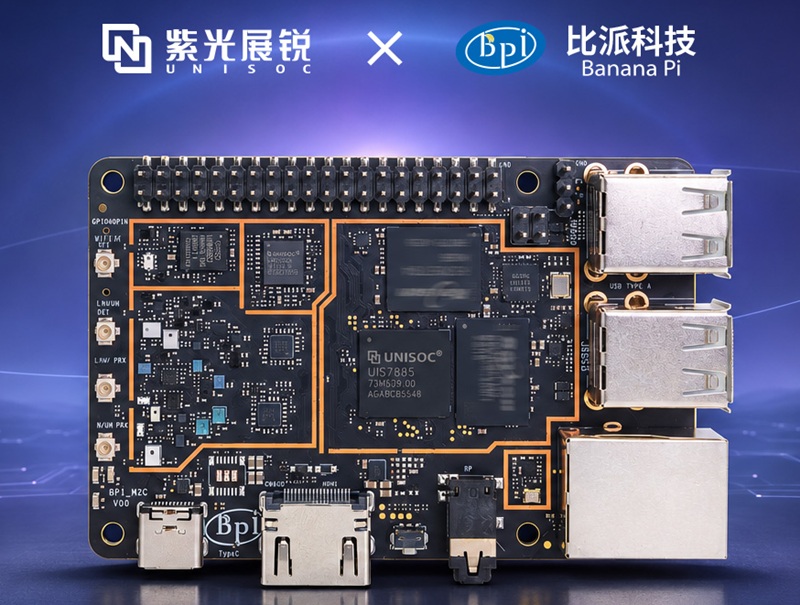
Built on a 6nm process, the UIS7885 features an octa-core architecture—comprising four high-performance Arm Cortex-A76 cores and four energy-efficient Arm Cortex-A55 cores—with a shared 3MB L3 cache. It supports Arm Neon SIMD/VFP instructions and integrates a Mali-G57 GPU, an IMG AX3596 NPU, a VDSP, an ISP, and hardware-based video encoding/decoding units. The BPI-M2C comes equipped with 4 GiB of LPDDR4X RAM and 128 GB of eMMC storage. Its interface suite includes support for MicroSD, PCIe Gigabit Ethernet, Wi-Fi, Bluetooth, GNSS, HDMI, MIPI-DSI, MIPI-CSI, USB, and a 40-pin expansion header.
Compared to typical entry-level development boards, the BPI-M2C places a greater emphasis on high-performance computing, 5G platform capabilities, on-device AI, camera ISP, and multimedia processing. It is well-suited for development projects that require an integrated solution for computing, connectivity, display, and vision-based tasks.
Key Features
- 1 × Arm Cortex-A76 (up to 2.7 GHz) + 3 × Arm Cortex-A76 (up to 2.3 GHz) + 4 × Arm Cortex-A55 (up to 2.1 GHz)
- Arm Mali-G57 GPU (up to 850 MHz)
- IMG AX3596 NPU (up to 988 MHz)
- VDSP (Vision/Signal Processing Unit) (up to 1014 MHz)
- 4 GiB LPDDR4X RAM
- 128 GB eMMC, with support for MicroSD
- Gigabit Ethernet
- Wi-Fi 5 (dual-band: 2.4 GHz, 5 GHz) / Bluetooth 5
- Software/driver support for GNSS and FM
- Integrated 2G/3G/4G/5G modem within the SoC
- HDMI output
- MIPI-DSI
- MIPI-CSI
Target Applications
- 5G edge computing gateways
- Machine vision and AI-enabled cameras
- Smart retail, self-service terminals, and digital signage
- Facial recognition and smart access control
- Industrial HMI and all-in-one touch terminals
- Video conferencing, remote monitoring, and video transmission
- Robot main control and vision processing
- GNSS-based mobile data collection terminals
- Educational platforms for ARM/Linux, AI, and telecommunications (for universities/colleges)
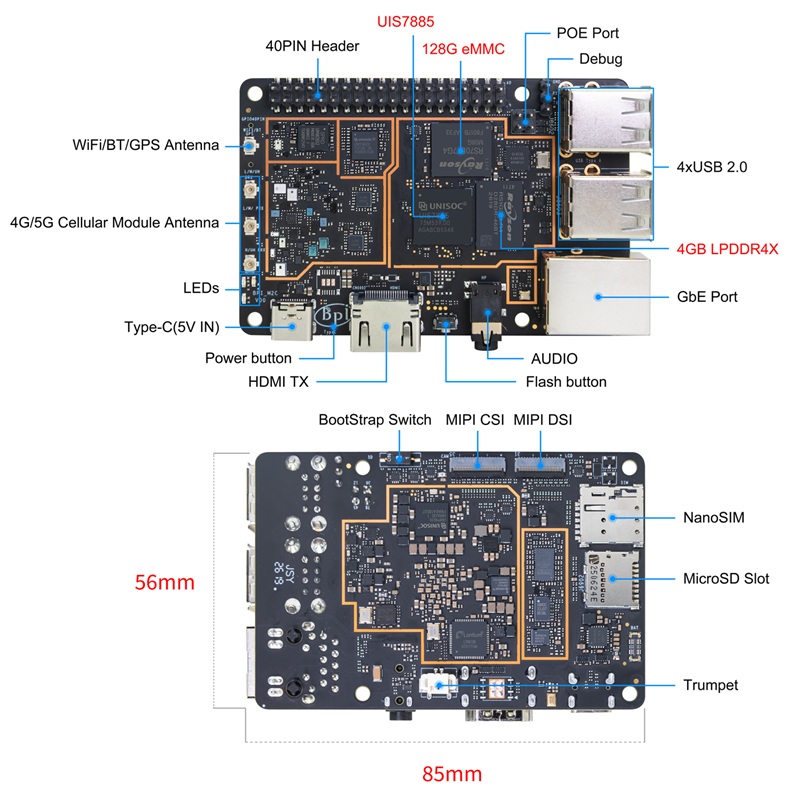
Hardware interface:
WIKI documents: