The "RAMageddon" Price Hike is Real - Incoming to BPI

Sadly, straight from the horse’s mouth, we are looking at a massive price hike on new batches of Banana Pi products. I reached out to the BPI Shop, and they confirmed my worst fears: significant price increases are coming for any new inventory.

While existing stock might stay steady for a moment, if you’re waiting for the BPI R4 Pro 8X (or any DRAM-heavy SBC), expect the price to rise sharply. In 2026, the rule is simple: the more RAM a board has, the harder your wallet is going to get hit. If you currently debating whether or not to buy a product from BPI, I recommend you do not wait, once those stocks are depleted, there is a huge chance of a massive price hike on new stock.

My Experience & The Price Gouging

I originally managed to snag the BPI R4 Pro for $218.00 USD, but unfortunately, my unit developed a fault within the first week. I returned it to the SinoVoIP AliExpress store and got my account credited. However, when I went to buy a replacement, the landscape had changed completely:

  • Official Stock is Gone: SinoVoIP has delisted the board from their main AliExpress store.
  • Price Gouging: Third-party sellers (like the MII Store (AVOID)) are now listing units with markups as high as $400 to $600 MSRP.
  • New Reality: Evidence suggests the “official” restock price may be as high as double what it was at launch.

Too Much

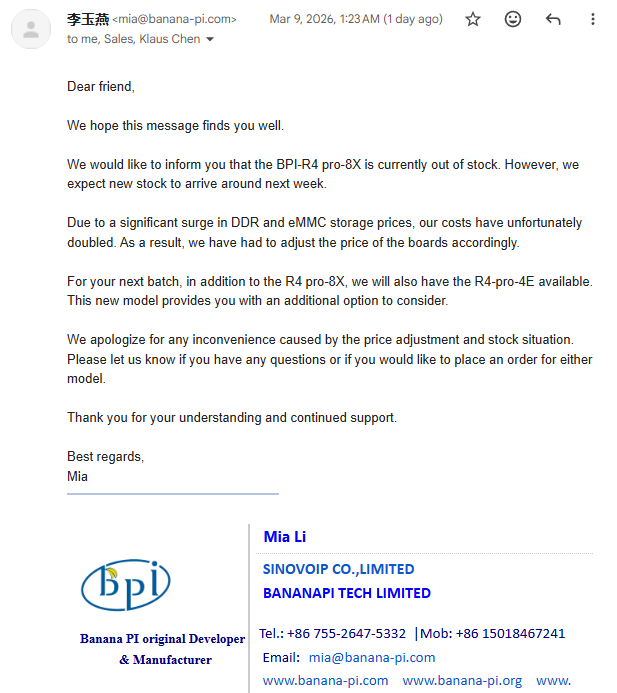
At $400+, this board is officially out of my budget. I simply can’t justify spending that much on an SBC router—especially one that still doesn’t have a stable, mainstream build of OpenWrt. It’s a great piece of hardware, but at double the price, it loses the “bang-for-your-buck” appeal that makes Banana Pi worth the software headache. From the email I received it looks like BPI is banking on customers opting to migrate the hikes by opting to purchase the product with less ram, less emmc, and most likely this unit will cost more than what it cost to buy the 8GB version.

From my own research, price is from September 2025 and March 2026 prices:

8GB DDR4 RAM ~$20.00 ~$65.00+ +225%
8GB eMMC 5.1 ~$4.00 ~$9.00 +125%

So if BPI increases prices between $50 to $200 extra on devices, then At these prices, BPI’s sales will crater. They are losing the very ‘price-to-performance’ edge that built their community.

Image from BPI Tech Limited.
1 Like

If you live in Europe: 8gb version from Conrad.

Hi Haldi,

While they have remaining stock Conrad is selling the board for 321.99 Euros which is $386.21 USD, that’s a whopping 77.16% over the RRP price, and likely even more expensive when they run out and get more in.

image

Now the prices of memory and storage are completely out of control. When the inventory runs out, we have to pay a high cost for it.

Damn, the prices have literally doubled. I wanted to order another R4 for myself, went to AliExpress and was shocked by the prices.

I just hope all this will not delay/postpone the upcoming new version of the BE14 WiFi 7 board…

The price hikes on the BPI-R4 Pro are a massive blow to its appeal, especially while the BE14 remains essentially a paperweight.

​We’ve seen plenty of R4 Pros move, but the BE14 has been a disaster. Vendors are still offloading first-gen modules at ‘reduced’ rates despite well-documented hardware flaws—specifically the zeroed-out TX power tables and abysmal signal penetration caused by a lack of PA isolation.

​While rumors of a hardware revision are circulating, there is zero transparency on a release date. Expecting users to pay a ‘premium’ price for a base board while waiting indefinitely for a working Wi-Fi 7 module is a huge ask. It raises serious concerns about the long-term viability of the board if the ‘entry fee’ keeps climbing. I managed to secure an R4 Pro at a fair price, but after it went faulty through no fault of my own, I now find myself priced completely out of a replacement.

​If BPI continues to inflate these costs, the value proposition vanishes. In 2026, DRAM and SSD costs have surged by over 130%, with some memory spot prices jumping 90% in a single quarter.

While bigger companies like Ubiquiti, Cisco, and TP-Link have contractually locked-in prices and massive inventories, they are mitigating the damage far better. Most major manufacturers are absorbing the brunt of this, passing back mere 3–10% increases to the customer.

In contrast, BPI’s total exposure to the spot market is forcing 70–100% price hikes onto the enthusiast. ​If I’m going to pay premium prices, I’d rather spend that money on a UniFi Gateway (like the UCG-Max or UCG-Fiber). With Ubiquiti, I get a stable ecosystem, guaranteed warranty support, and hardware that works out of the box.

If BPI is going to attempt to survive this, they are going to have to pull up their boots, put their raincoats on, and wait for the storm to pass while accepting losses , maintaining break-even profits, or smaller margins. They should aim for the same increases as the other manufacturers, I’m hearing rumours of 50 to 100% price increases which is far greater than the other networking companies. This takes low cost products into the premium range.

This shortage is expected to last until at least 2027; if they don’t tighten their own belts and protect their customers, there won’t be a market left for them when the sun finally comes back out.

1 Like

thanks for that information, just bought mine for 239 CHF from conrad. 218 US $ is about 175 CHF, + 20CHF for the tax process, +3% of the complete price + shipping + 8.1% tax, guess its more or less equal to what i would have paid when buying from aliexpress (before RAMagaddon)

Yea, Conrad seems to price differently, for me it comes up as 263 CHF includes shipping and taxes, better than Ali Express.

Part of me is saying just order it and suck it up, but for all we know they’re working on a revision of the board with the INA sensor included and not left missing. Not much transparency, but this applies to most manufacturers.

they are also working on BE19 for about … a year now? :stuck_out_tongue: What is this “INA sensor”?

i guess he means the voltage/current measurement chip ti,ina226 on pca9545 channel 0 addr 0x40 referenced in downstream dts, but not there on current boards

ok and for regular mortals like me :smiley: what does that do or why is this important?

I do not know this chip/class deeper,but imho you can monitor power usage via i2c on the board,not sure if this only has 1 measuring point or more.

Also available as module:

DC 0-36V 20A INA226 Current Voltage Monitoring Sensor Module IIC I2C Interface Bi-directional Zero-Drift Breakout Board https://a.aliexpress.com/_Ev8az6c

The INA is more than a safety measure more than anything, the i2c is fairly dumb in what it knows about the fans being used, especially since there is no techometer. A seized fan (locked rotor) for example creates a situation of low resistance with high current which can either damage the fan, or in worst cause scenarios damage the board.

High-end server boards generally use these type of sensors to monitor the fans, most consumer x64 motherboards use SIO chips with techometer readings and these have to way of stopping delivering current to fans but motherboards are less sensitive, the high quality copper traces essentially are able to convert that current into heat without failing on the board, but the MOSFETs do suffer from fatigue.

It’s possible that’s why my 12v rail failed, I had just installed two new fans, one of those could of had a fault and stalled, they ain’t Noctua or Delta premium fans which have current protection and pulse restart on stall.

It’s not essential to have these sensors assuming BPI have done risk assessments in the events of a failing fan and concluded it’s low risk damage to the copper traces and the MOSFETs.

If the copper traces and MOSFETs are unable to handle the current, a protection sensor becomes more of an essential than a luxury. It would be interesting to know if they planned to use an INA as an added bonus, or because they felt it was an essential, the fact it’s there in the schematics, is a red flag imo.

In short a trouble fan with the GPIO and sensors, it can turn of the current when it detects an issue.

Feature Standard I2C Fan Controller INA226 Power Monitor
Primary Metric Pulse Width Modulation (PWM) % Current (I), Voltage (V), & Power (P)
Speed Detection Blind. Assumes the fan is spinning at the requested %. Inferred (Virtual Tach). Detects “Current Ripples” to estimate RPM.
Stall Alert No Alert. Keeps sending power to a seized motor. Instant Alert. Detects the massive Current Spike of a stall.
Bearing Health Impossible. Cannot see physical motor drag. Predictive. Detects “Current Creep” as bearings add friction.
Obstruction Sensing None. Cannot tell if the air intake is blocked. Possible. Detects a Current Drop when blades spin in “stalled air.”
Failure Detection Only if the circuit is physically broken. Complete. Detects Under-current or Over-current conditions.
Precision Logic Sends signal and “hopes” for airflow. Monitors Voltage Sag and adjusts power for steady airflow.
Wiring Required I2C Logic + PWM Power Lines. I2C Logic + Inline Shunt (Pos or Neg rail).

Yep seen these and to add there is plenty of dedicated multi header fan controllers with there own internal protections, speed control, alerts, techometers, speed base on temp and with LCD displays for extremely low costs.

I think my mistake was using cheap fans (2x thermalright high static pressure 120mm fans) which have fair less internal protections when compared to the likes of noctua and delta fans.

It’s possible my board went faulty because I was being a cheap arse with buying cheap fans, combined with BPI being a cheap arse by not soldering that INA and that resulted in the 12v rail losing it’s ability to output meaningful current :laughing:

that means, using noctua regular users should be fine?

Hi Oli,

Noctua fans rely on their proprietary NE-FD1 and the newer NE-FD6 (G2 series) driver ICs to handle electrical safety. While the older NE-FD1 is highly reliable, the NE-FD6 offers more precise control and quicker response to electrical faults.

Core Protection Features:

  • Over-current Protection: Actively limits or shuts down power if a short or surge is detected, protecting the BPI R4 Pro fan header.
  • Over-voltage Protection: Designed to handle standard 12V/5V drifts; it protects the internal circuitry from being fried by power supply surges.
  • Reverse Polarity Protection: A critical feature for DIY projects like the BPI R4 Pro, ensuring the fan isn’t destroyed if wired incorrectly (especially on 5V models).
  • Back EMF / Spin Protection: Prevents the fan from acting as a generator and sending voltage back to the BPI R4 Pro when freewheeling, though manual restraint of the blades is still recommended during cleaning.
  • Locked Rotor Protection & Auto-Restart: If a cable jams the blades, the IC cuts power to prevent a fire hazard and periodically attempts to restart until the path is clear.

Yes, I noticed the massive price increase on the BPI-R4 on AliExpress recently. For me with 25% VAT, it’s an increase from roughly $160 to $340 for the 8 GB RAM model. On sale, the 4 GB model has gone as low as $100 in the past. Now it’s $300.

I’m glad I bought a spare 8 GB RAM model for $140 before the price hike. :slight_smile: I did so because I expected the price to increase, but not this dramatically.

Sadly, I got mine when it was cheap, but it went faulty within a month. :face_with_symbols_over_mouth:

Beyond just the price tag, this massive hike directly threatens the actual lifespan of the BPI R4 Pro. You rely entirely on the OpenWrt community to make the hardware viable. OpenWrt is driven by volunteers who only develop for the hardware they physically own. If sales slump because you have priced the item out of the DIY market, the developer pool shrinks. When developers move on to more affordable boards, nobody is left to update the code, test system upgrades, or fix bugs. A small user base is a death sentence for hardware in the OpenWrt world. By protecting your margins today, you are actively killing the long-term community support your board needs tomorrow.

To put things into perspective, it’s not just $300 now. For buyers in the States, it sits around $393.91, and for those of us in the UK, it is far worse—roughly $443.61 (£336.07) after taxes and fees.

UK Import Breakdown

  • Item Price: £264.66
  • Postage: £5.40
  • Import VAT (20%): £54.01
  • Handling Fee: £12.00 (Standard 2026 ParcelForce/DHL rate)
  • Total: £336.07 ($443.61 USD)

US Import Breakdown

  • Item Price: $350.94
  • Postage: $7.16
  • Global Tariff (10%): $35.81 (New flat rate on small parcels)
  • Total: $393.91

I’ve ranted more about this here: BPI R4 Pro 8GB Price Hike Just Landed on Ali: 58% Increase - #4 by SimonHayterUK

Sadly, for a lot of us, this price hike changes a great DIY purchase into a very questionable one. You are officially paying “Enterprise” prices for a bare board. When you enter that price bracket, the rules change entirely. It is no longer about who has the most RAM or the fastest CPU on paper. It is all about optimization and the ecosystem.

The entire appeal of OpenWrt is taking cheap hardware and unlocking high-end routing features that basic stock firmware hides. It lets you turn an affordable, older router or a cheap SBC into a powerhouse.

But once you cross into enterprise pricing, that DIY advantage vanishes entirely. At $400+, you no longer need to build it yourself to unlock that power. Reputable manufacturers already give you those advanced features unlocked right out of the box—fully polished, heavily optimized, and backed by private hardware drivers that are never released to the public.

Enterprise gear doesn’t rely on brute force; it uses custom software built specifically to match that exact hardware. OpenWrt is amazing, but it is forced to adapt to whatever hardware you throw at it. The big companies build the hardware and software to work perfectly together from day one, and for $400+, that is exactly what customers expect. Also with enterprise grade routers you get enterprise grade RMA processing, e.g. quick replacements, between 2-5 years in warranty.

Can you tell I’m sour /rant over! :laughing: