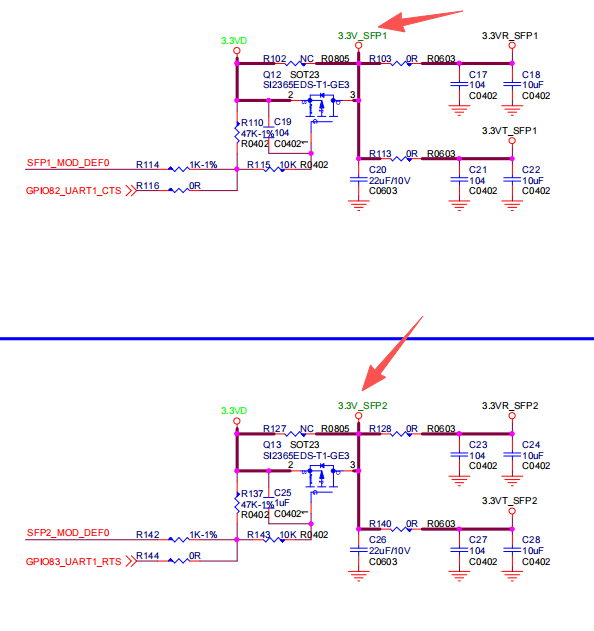
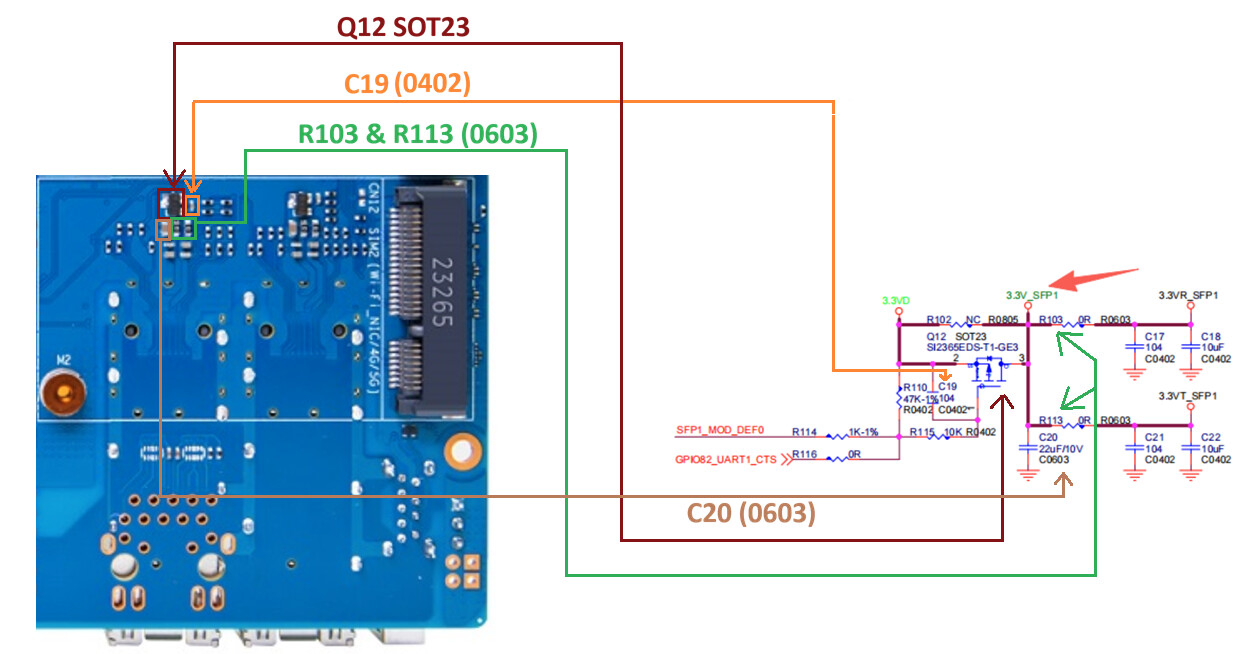
After about 1 year of use the VCC on the SFP+ slots is now too high. It should be 3.30V but module tells me it’s 3.50V and triggered the ALARM today. Before I was wondering already for weeks now why upload became slow and XGSPON ISP sometimes disconnects me – now I know why!
So on schematics I can see that 3.3V is generated by MP8759GD stepdown part. In the datasheet of that part I read “1% Reference Voltage”, but in reality is 6% deviation by now. I’m not so much into electronics, but something must be wrong here.
I’m using the original BPI case with fan, so temperature is not the problem. Also strong and reliable 12V 5A power supply should to supply the R4, and no WiFi or M.2 module installed, just XGSPON SFP+ and DAC cable to a switch.
@simon Please provide me with instructions how to check and repair the board.
sfp1-isa-0000
Adapter: ISA adapter
VCC:           3.50 V  (crit min =  +0.00 V, min =  +0.00 V)  ALARM (MAX)
                       (max =  +0.00 V, crit max =  +0.00 V)
temperature:  +57.8°C  (low  =  +0.0°C, high =  +0.0°C)
                       (crit low =  +0.0°C, crit =  +0.0°C)
TX_power:      3.60 mW (max =   0.00 W, min =   0.00 W)
                       (lcrit =   0.00 W, crit =   0.00 W)
RX_power:      6.00 uW (max =   0.00 W, min =   0.00 W)
                       (lcrit =   0.00 W, crit =   0.00 W)
bias:         19.00 mA (crit min =  +0.00 A, min =  +0.00 A)
                       (max =  +0.00 A, crit max =  +0.00 A)